The Monthly Buy Plan: A Budget You Can Hit, Every Month, Every Banner
Franchisees and multi-banner retailers are held to a periodic buying budget, and hitting it by category and by month — not just by year — is the actual job. That job gets harder because most of what a retailer buys each period — new products, new suppliers, one-time close-outs — has never been sold before; for retailers where new items make up 80% or more of procurement, that's the rule, not the exception. The Monthly Buy Plan turns a budget into next year's purchase plan: how many units to buy, by category and by month. A dollar figure comes along for the ride, but the quantity is what a buyer actually acts on.
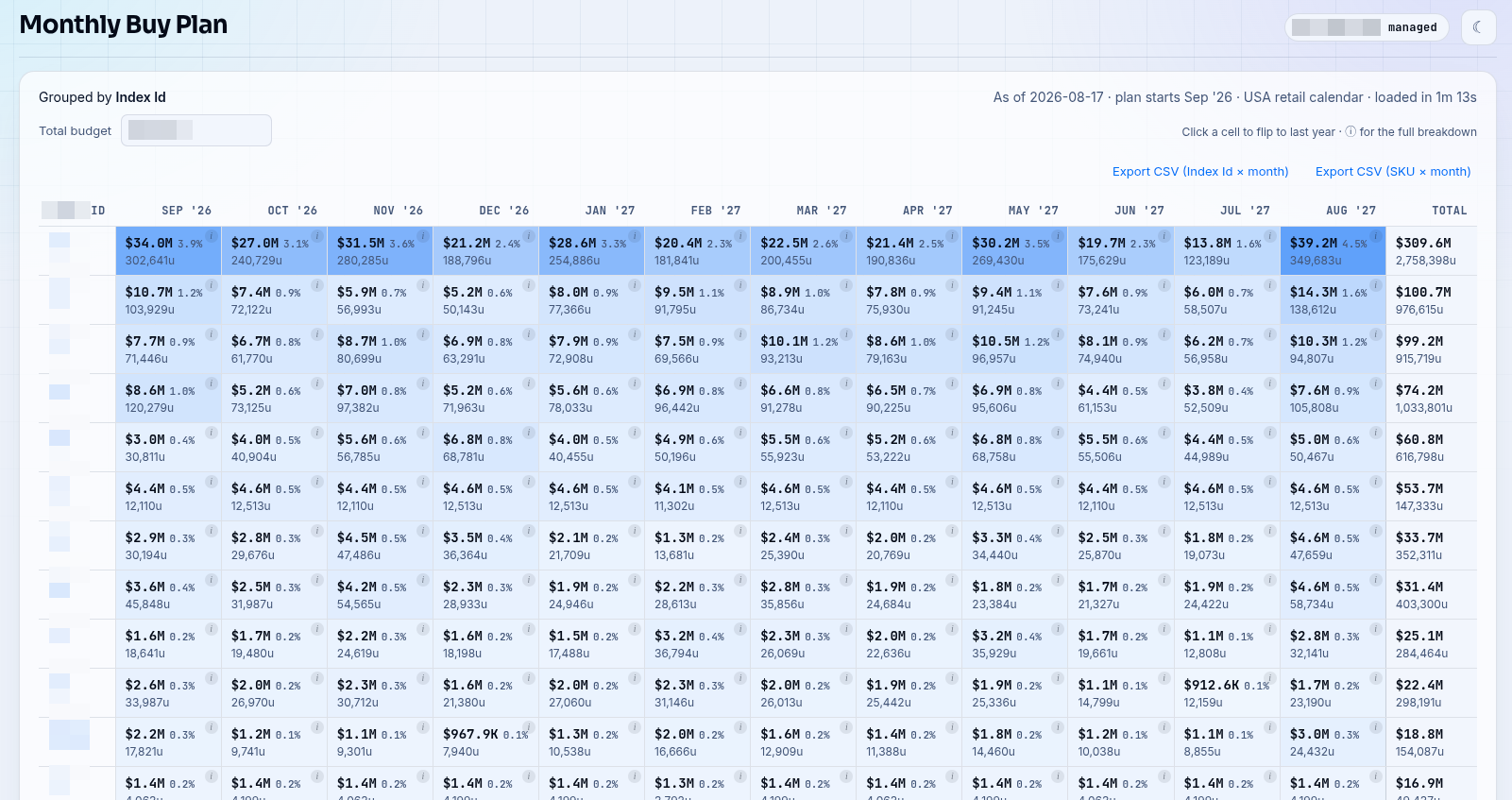
Plan by Category, Not by Item
Each client sets a main category — and, where useful, a sub-category — once, in Settings. From there the plan computes the dollar and unit target for every category-by-month box automatically, from that category's own seasonal pattern, like the grid above. Every category always drills down into its own sub-category breakdown, and the whole plan — or every SKU behind it — exports straight to a spreadsheet. What it doesn't do is pick products: that's the planner's call. The system decides how much to spend and where; a person still decides what to buy with it, from whatever's in the new catalog. For a franchise or multi-banner group, the same category structure runs per banner, so head office can hold every location to its own share of the budget without rebuilding the plan by hand for each one.
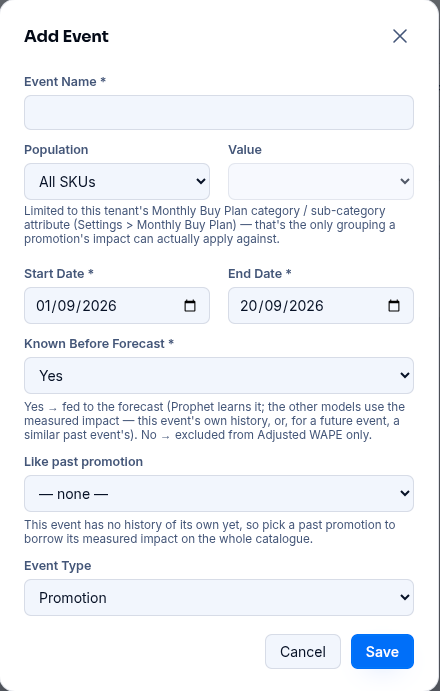
Promotions and Holidays Do the Heavy Lifting
A new promotion doesn't start from a guess — it borrows its effect from a similar one that already happened. Point it at last year's comparable sale and the plan carries that same, real lift forward: a 30% Father's Day lift last June becomes a 30% lift this June, before the promotion has even run. Holidays work the same way — whatever actually happened around Black Friday, Diwali, or back-to-school last time is folded into this year's plan automatically.
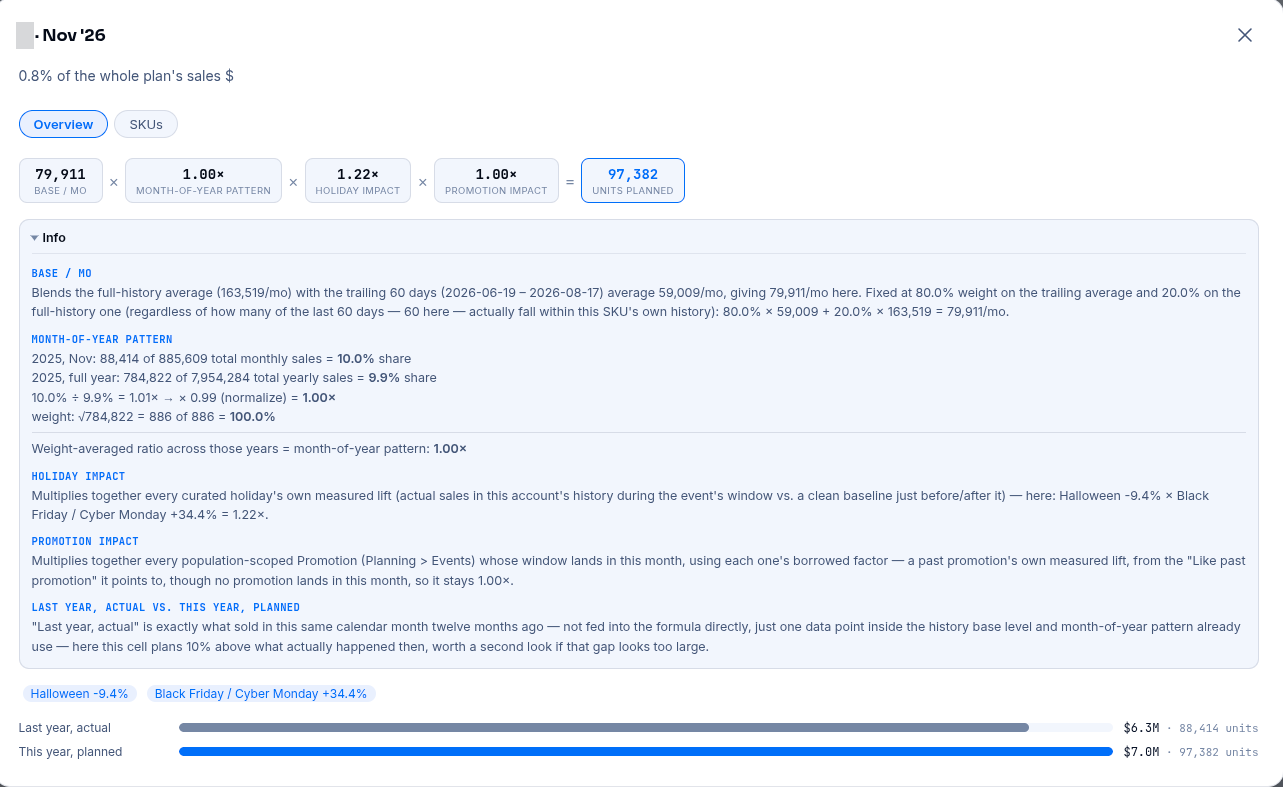
Nothing Here Is a Black Box
Click any box and see exactly how it was built, from four numbers multiplied together:
- Base — this category's recent and full-history sales, blended into one monthly run rate.
- Month pattern — how this category normally rises or falls across the year.
- Holiday — the lift from past holidays, pulled in automatically from sales history.
- Promotion — the lift borrowed from a similar past promotion, whenever one's scheduled in Events.
For example, November: 79,911 × 1.00 × 1.22 × 1.00 = 97,382 units — about 10% above what actually sold last year.
Set a Budget, See It Everywhere at Once
Change the total and every category, month, and banner rescales instantly — no rebuild, no waiting.
Plan From Day One
Works before a single unit of a new item has sold.
Gets Sharper Every Season
Each promotion and holiday becomes evidence for next year's plan.
buffers.ai already runs five forecasting models — TimesFM, LightGBM, Prophet, Exponential Smoothing, and Moving Average — to predict units for products with a track record. The Monthly Buy Plan solves a different problem: turning a periodic buying budget into category-and-month purchase quantities, for franchisees and multi-banner retailers as much as for products that don't have a sales track record yet.
Read next: How buffers.ai forecasts repeat items · Pricing
See it on your own categories
Talk to our team about your catalog and your next new-arrival budget, and we'll walk you through a Monthly Buy Plan built on your own data.